As we move into April, it's time for the annual One Book, One Community event here in Allegheny County. The committee responsible for selecting the title works hard and long on the process - I attended several of the meetings and can vouch for how seriously the members take their responsibility for selecting a title that is readable, interesting to a broad audience, yet has literary merit.
Using the 250th anniversary of Pittsburgh as a basis for considering titles, I believe the committee made a perfect selection. The title celebrates one of our finest residents, Fred Rogers. Mr. Rogers was and continues to be respected and beloved not only locally, but nationally and even internationally for the sincerity and caring he demonstrated at all times. A wonderful embodiment of what locals always reference when talking about Pittsburghers - we are friendly and good neighbors. That is one the of the first things I heard about when I moved here more than 25 years ago, and by celebrating this man, we celebrate ourselves.
So, read the book: I'm Proud of You, by Tim Madigan. It is a quick read and makes us consider the meaning of neighbor and mentor. The purpose of the One Book program is to try to get as many people in the community thinking about and discussing the same book. Being a bookmobile program, we are limited in how we can bring together you and our other users to discuss the book. I hope that many of you will go to As the Wheels Turn, our Book Discussion Forum, to do just that - talk about this book with others in your community. There will be various topics as starting points for a discussion, and you can always start your own discussion point for others to comment on. After all, it is the neighborly thing to do!
Book: Pay it forward
Movie: Pay it forward
Monday, March 31, 2008

Monday, March 17, 2008
Stepping outside of your comfort zone
At one of our stops is a delightful, older woman who lives in an old mill town. She seems to be someone who has lived there her whole life, just like so many in Western Pennsylvania. But there is one way she is unlike the expected stereotype - she is a foreign film fanatic. She takes out 5 - 10 each week, bringing in a list for next week with her. She watches films from all around the world, not just the classic directors - Fellini, Bergman - or the famous sources - France and Italy. I have ordered Iranian, Chinese, Japanese, Indian, and yes, Icelandic.
Now, I have dipped here and there into foreign films over the years. I loved Farewell My Concubine, watched the Virgin Spring in college. As a classics major I watched many foreign films that dealt with classic myths: Black Orpheus, Orphee, Oedipus the King. But in general, I didn't take any risks. After reserving these films for this woman for several years now, I decided to take the plunge and try a few that sounded particularly off-beat and interesting. If you have been reading this blog, you can guess I started with the Icelandic film Noi. What a fabulous film. It was interesting to hear the language - not at all what I expected, not similar at all to other Scandinavian languages. Seeing the local scenery and the way people live in Iceland was fascinating, but the story was so moving, funny and yet sad. I was glad I tried it. I then moved on to Tokyo Story. Another lovely film, very minimalistic, but a fascinating look at Japanese culture. Since then I have jumped headlong into it - just this past weekend I watched another Icelandic film The Seagull's Laughter.
Similarly, I have stepped further outside my comfort zone in reading books, taking a chance on biographies, fiction that isn't mysteries. There are far more hits than misses, and the best part of reading a book borrowed from the library is that if you don't like it you haven't wasted anything but a few minutes of your time. More often you have opened new worlds, discovered new ideas, and fresh or different ways of looking at life. I was desperate for an audiobook for my communte home a couple of years ago, and finally took a risk on what ended up one of the best books I have ever read - My Sister's Keeper, by Jodi Picoult, now a favorite author of mine. I never imagined I would enjoy such unsettling stories that never really tie up the story in a neat bundle.
So take a risk or two - close your eyes and just grab a book. We librarians take care in selecting books, and you will be hard pressed to find a title that either isn't by a tried and true author, or didn't get good reviews. Will every risky choice result in a book you like? No of course not, but you will like the book most of the time. Along the way you will find new favorite authors or genres. Your outlook will broaden, you will become more understanding of the people and world around us, you will enrich your life and find new ways to enjoy a quiet moment with a book or movie.
Movies: Adam's Apple
The Cuckoo
Book: Standing Still, by Kelly Simmons
Now, I have dipped here and there into foreign films over the years. I loved Farewell My Concubine, watched the Virgin Spring in college. As a classics major I watched many foreign films that dealt with classic myths: Black Orpheus, Orphee, Oedipus the King. But in general, I didn't take any risks. After reserving these films for this woman for several years now, I decided to take the plunge and try a few that sounded particularly off-beat and interesting. If you have been reading this blog, you can guess I started with the Icelandic film Noi. What a fabulous film. It was interesting to hear the language - not at all what I expected, not similar at all to other Scandinavian languages. Seeing the local scenery and the way people live in Iceland was fascinating, but the story was so moving, funny and yet sad. I was glad I tried it. I then moved on to Tokyo Story. Another lovely film, very minimalistic, but a fascinating look at Japanese culture. Since then I have jumped headlong into it - just this past weekend I watched another Icelandic film The Seagull's Laughter.
Similarly, I have stepped further outside my comfort zone in reading books, taking a chance on biographies, fiction that isn't mysteries. There are far more hits than misses, and the best part of reading a book borrowed from the library is that if you don't like it you haven't wasted anything but a few minutes of your time. More often you have opened new worlds, discovered new ideas, and fresh or different ways of looking at life. I was desperate for an audiobook for my communte home a couple of years ago, and finally took a risk on what ended up one of the best books I have ever read - My Sister's Keeper, by Jodi Picoult, now a favorite author of mine. I never imagined I would enjoy such unsettling stories that never really tie up the story in a neat bundle.
So take a risk or two - close your eyes and just grab a book. We librarians take care in selecting books, and you will be hard pressed to find a title that either isn't by a tried and true author, or didn't get good reviews. Will every risky choice result in a book you like? No of course not, but you will like the book most of the time. Along the way you will find new favorite authors or genres. Your outlook will broaden, you will become more understanding of the people and world around us, you will enrich your life and find new ways to enjoy a quiet moment with a book or movie.
Movies: Adam's Apple
The Cuckoo
Book: Standing Still, by Kelly Simmons
Monday, March 3, 2008
A bit of follow-up
I thought I would take this opportunity to update some of my previous postings:
Scandivanian mysteries - particularly the Icelandic ones:
I tried a new author: Yrsa Sigurdardottir - Last rituals. It was ok but I think it suffered a bit during translation. However, it is a great way to see Icelandic life, a lot of time is spent on the main character's life. She is a single mom who is establishing a legal practice. It also provides insights into the way Europeans move around various countries like we move around the various states. It is worth a read, but it didn't wow me.
I read the next title by Arnaldur Indridason - Voices. He is my favorite and I wasn't disappointed with this one. It was lovely and dark, nicely developing the characters in this series while expanding our look at Icelandic life, and the mystery is decent too, not only keeping you guessing, but exploring themes of the risks of child stars and children growing up with absent (either physically or emotionally) parent. I really recommend it.
I also had the chance to see a travel DVD on Iceland and Greenland. Way too little about Iceland, but well worth seeing for the risks due to the sudden changes in weather. The host is traveling in April and they are stuck due to a sudden massive (to us) snowfall. It is an interesting underlining of the lost forever in storms that is a constant theme in Arnaldur's books.
The end of the book as we know it:
Once again, there has been a rash of articles predicting and mourning the end of the book, the demise of reading and even the demise of libraries. One article predicted that reading would be an arcane hobby done by a few oddballs. Another based the end of reading and the book on the 4% drop in sales at bookstores (over 5 years) - no mention of the steep rise in prices, the downturn of the economy (and the growth in library use) as possible contibutors to this. Still another in a posting about new library buildings in the US predicted that libraries would be a thing of the past by 2019. All due to the Internet. I keep this all in perspective, remembering all those weeded book predicting that all oil reserves would be exhausted by 1990. After all, the Internet has been supposedly killing libraries for the past 10 years and library use is actually booming. The face of what a library is and does is of course changing with the changing culture - just like it has forever.
I was talking to a colleague who was describing a project at her local high school where students were creating a new civilization from scratch and had to decide what services to include. When the students didn't select libraries, she reminded them that libraries are never just warehouses of books, rather libraries collect, store and distribute human knowledge, the how-to for everything. Not only instructions on how to cook, but also how to live a life. Fiction, after all, gives insight into the puzzle of human behavior. She posed the question - when you build your road, where will you keep the directions on how to build another so that future generations will know how to do it without starting all over? Apparently even the teacher had not considered this aspect.
Most interesting to me was an article by Ursula Le Guin in this February 2008's issue of Harper's. I wish the whole article was available on line, but you can get the magazine issue from your library. The article is called "Staying Awake: Notes on the Alleged Decline of Reading" and is in response to a recent NEA report on the demise of reading entitled "To Read or Not to Read" and an AP article by Alan Fram quoting a telecommunications project manager saying ' I just get sleepy when I read". Ursula discusses that except for a brief period of history, not that many people read at all. She also argues that big corporate business getting into the publishing business is strangling the publication of interesting but not necessarily James Patterson huge titles. That the focus on ever growing returns has cut off the availability of older titles that in the past were steady sellers and the bread and butter of publishers. An interesting counterpoint to much else that is being written.
Book: Hirsch, E. D. - The Knowledge Deficit: closing the shocking education gap for American Children
Movie: Lathe of Heaven (based on an Ursula Le Guin story - for you non-readers!)
Scandivanian mysteries - particularly the Icelandic ones:
I tried a new author: Yrsa Sigurdardottir - Last rituals. It was ok but I think it suffered a bit during translation. However, it is a great way to see Icelandic life, a lot of time is spent on the main character's life. She is a single mom who is establishing a legal practice. It also provides insights into the way Europeans move around various countries like we move around the various states. It is worth a read, but it didn't wow me.
I read the next title by Arnaldur Indridason - Voices. He is my favorite and I wasn't disappointed with this one. It was lovely and dark, nicely developing the characters in this series while expanding our look at Icelandic life, and the mystery is decent too, not only keeping you guessing, but exploring themes of the risks of child stars and children growing up with absent (either physically or emotionally) parent. I really recommend it.
I also had the chance to see a travel DVD on Iceland and Greenland. Way too little about Iceland, but well worth seeing for the risks due to the sudden changes in weather. The host is traveling in April and they are stuck due to a sudden massive (to us) snowfall. It is an interesting underlining of the lost forever in storms that is a constant theme in Arnaldur's books.
The end of the book as we know it:
Once again, there has been a rash of articles predicting and mourning the end of the book, the demise of reading and even the demise of libraries. One article predicted that reading would be an arcane hobby done by a few oddballs. Another based the end of reading and the book on the 4% drop in sales at bookstores (over 5 years) - no mention of the steep rise in prices, the downturn of the economy (and the growth in library use) as possible contibutors to this. Still another in a posting about new library buildings in the US predicted that libraries would be a thing of the past by 2019. All due to the Internet. I keep this all in perspective, remembering all those weeded book predicting that all oil reserves would be exhausted by 1990. After all, the Internet has been supposedly killing libraries for the past 10 years and library use is actually booming. The face of what a library is and does is of course changing with the changing culture - just like it has forever.
I was talking to a colleague who was describing a project at her local high school where students were creating a new civilization from scratch and had to decide what services to include. When the students didn't select libraries, she reminded them that libraries are never just warehouses of books, rather libraries collect, store and distribute human knowledge, the how-to for everything. Not only instructions on how to cook, but also how to live a life. Fiction, after all, gives insight into the puzzle of human behavior. She posed the question - when you build your road, where will you keep the directions on how to build another so that future generations will know how to do it without starting all over? Apparently even the teacher had not considered this aspect.
Most interesting to me was an article by Ursula Le Guin in this February 2008's issue of Harper's. I wish the whole article was available on line, but you can get the magazine issue from your library. The article is called "Staying Awake: Notes on the Alleged Decline of Reading" and is in response to a recent NEA report on the demise of reading entitled "To Read or Not to Read" and an AP article by Alan Fram quoting a telecommunications project manager saying ' I just get sleepy when I read". Ursula discusses that except for a brief period of history, not that many people read at all. She also argues that big corporate business getting into the publishing business is strangling the publication of interesting but not necessarily James Patterson huge titles. That the focus on ever growing returns has cut off the availability of older titles that in the past were steady sellers and the bread and butter of publishers. An interesting counterpoint to much else that is being written.
Book: Hirsch, E. D. - The Knowledge Deficit: closing the shocking education gap for American Children
Movie: Lathe of Heaven (based on an Ursula Le Guin story - for you non-readers!)
Monday, February 18, 2008
Why we do it . . .
I got an interesting email this week from a listserv for bookmobilers. It included some old photos of horse bookmobiles in Kentucky, well specifically Pack Horse Librarians. These librarians worked back in the middle of the last century bringing books to people up in the mountains far from libraries.
Librarian delivering a book:

The whole crew before setting out:
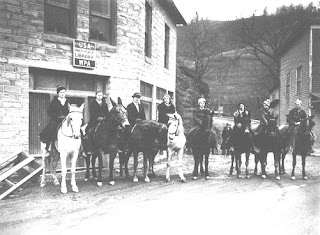
It's interesting to see how many ways are found to make sure people have access to books.
Today in Africa there are Camel Bookmobiles in Kenya and Donkey Bookmobiles in Zimbabwe. There is Epos in Norway, a book boat. There is a floating bookmobile in Alaska providing Native Americans access to library materials. Bookmobiles can be found all over the world - in Australia, Sri Lanka, Croatia, China, South America, India - you name it, there is probably a bookmobile. I have been contacted several times by organizations in Saudi Arabia asking for advice on starting and running a bookmobile.
In places with small population density or widely scattered settlements bookmobiles fill their traditional role of bringing the library to the citizens. But with the developement of urban centers, the need for bookmobiles have not diminished. Bookmobiles are strong around the world in urban areas as an inexpensive alternative to buildings providing the flexibility to go where the public lives. In Ireland and other areas of the U.K., bookmobiles are replacing libraries because of their relative inexpensiveness. In cities like Toronto Canada, libraries provide a strong urban service along side of traditional branches. In urban areas the barriers to service is not a sparse, widely scattered population, rather the barriers are major roads, lack of personal transportation, tough neighborhoods and parents having to work long hours rather than being available to take children to the library. It is easy to forget that not everyone has access to a car, that using public transportation to a library can be a challenge, especially with small children. This was brought to all our notice when the MLK Reading Room closure was announced. Many parents in the Hill District had safety concerns if the children had to walk to another library outlet, however close.
Although bookmobiles have been in the U.S. for over 100 years, there is no sign of a fading of the need, the use or the existence. All over the U.S., communities are starting new service and they can be found, just like here in Allegheny County, in densely populated areas - New Jersey, Ohio, Florida. Click here and find a list of just a few of the bookmobile services around the country. We bookmobilers are passionate about the service - and not just because it is our livelihood. We are on the front lines, seeing the importance of what we do. We see the elderly resident of an assisted living center coming out by walker to pick up a romance, we see the Head Start student coming out and being thrilled to be allowed to pick out his/her own book, we see everyday people, tired at the end of a long day working, bringing their kids to the bookmobile because they know it is important for the kids no matter how tired the parent might be. Why do we do it? As it says in one of our slogans - We are driven to serve. We know the importance of literacy in all its forms, know the importance of providing access for all sorts of people, and we know if we weren't there, most of these people would not have that chance to read.
Book: Case of the Missing Books, by Ian Sansom
Book: The Camel Bookmobile, by Masha Hamilton
Kids Book: Mystery of the Bewitched Bookmobile, by Florence Parry Heide
Movie: Stanley and Iris
Librarian delivering a book:

The whole crew before setting out:

It's interesting to see how many ways are found to make sure people have access to books.
Today in Africa there are Camel Bookmobiles in Kenya and Donkey Bookmobiles in Zimbabwe. There is Epos in Norway, a book boat. There is a floating bookmobile in Alaska providing Native Americans access to library materials. Bookmobiles can be found all over the world - in Australia, Sri Lanka, Croatia, China, South America, India - you name it, there is probably a bookmobile. I have been contacted several times by organizations in Saudi Arabia asking for advice on starting and running a bookmobile.
In places with small population density or widely scattered settlements bookmobiles fill their traditional role of bringing the library to the citizens. But with the developement of urban centers, the need for bookmobiles have not diminished. Bookmobiles are strong around the world in urban areas as an inexpensive alternative to buildings providing the flexibility to go where the public lives. In Ireland and other areas of the U.K., bookmobiles are replacing libraries because of their relative inexpensiveness. In cities like Toronto Canada, libraries provide a strong urban service along side of traditional branches. In urban areas the barriers to service is not a sparse, widely scattered population, rather the barriers are major roads, lack of personal transportation, tough neighborhoods and parents having to work long hours rather than being available to take children to the library. It is easy to forget that not everyone has access to a car, that using public transportation to a library can be a challenge, especially with small children. This was brought to all our notice when the MLK Reading Room closure was announced. Many parents in the Hill District had safety concerns if the children had to walk to another library outlet, however close.
Although bookmobiles have been in the U.S. for over 100 years, there is no sign of a fading of the need, the use or the existence. All over the U.S., communities are starting new service and they can be found, just like here in Allegheny County, in densely populated areas - New Jersey, Ohio, Florida. Click here and find a list of just a few of the bookmobile services around the country. We bookmobilers are passionate about the service - and not just because it is our livelihood. We are on the front lines, seeing the importance of what we do. We see the elderly resident of an assisted living center coming out by walker to pick up a romance, we see the Head Start student coming out and being thrilled to be allowed to pick out his/her own book, we see everyday people, tired at the end of a long day working, bringing their kids to the bookmobile because they know it is important for the kids no matter how tired the parent might be. Why do we do it? As it says in one of our slogans - We are driven to serve. We know the importance of literacy in all its forms, know the importance of providing access for all sorts of people, and we know if we weren't there, most of these people would not have that chance to read.
Book: Case of the Missing Books, by Ian Sansom
Book: The Camel Bookmobile, by Masha Hamilton
Kids Book: Mystery of the Bewitched Bookmobile, by Florence Parry Heide
Movie: Stanley and Iris
Monday, February 4, 2008
Time goes by . . .
I know it is a sign of age to feel that time is going by too fast, but I am still surprised to see that it is February already and since Christmas seemed just a few weeks ago, Punxatawney Phil's prediction of another 6 weeks of winter doesn't seem that bad. Now, the heat of summer bearing down on us is another issue entirely.
But if you take a moment to consider time and its passage, it can be a shocking and surprising thing. I came across the Beloit Mindset List today, and reading through the 2011 list was as usual a tough thing to wrap your mind around. In case you aren't familiar with it, it is an annual list put together by people at Beloit College that lists realities about the incoming class - what they don't know about, what they have lived their whole lives experiencing, basically what their world view is compared to ours. There are usually about 70 entries ranging from those that are surprising to those that even you don't know. I took the time to have a young woman currently in college who is roughly the age of the Class of 2011 read through the list and see how accurate it really is. I was startled at what she didn't know from the list!
Nelson Mandela has always been free and a force in South Africa. This young person didn't even know who Nelson Mandela is.
Pete Rose has never played baseball. Didn't know who Pete Rose is.
Women have always been police chiefs in major cities. Didn't know there were female police chiefs.
And one I expected, but was still distressed to be proved right:
Tiananmen Square is a 2008 Olympics venue, not the scene of a massacre. Didn't know Tiananmen Square.
History seems to be slipping out of the national conscious and from the school curriculum. Incidents that will stick it your memory forever never even blip on another generation. I can so vividly remember sitting and breathlessly watching the unfolding of the Tiannanman Square protest and massacre, marvelling at the bravery of these young protesters. Just 20 years later, and it is lost in the mists. Back in my school days, we rarely got past the Great Depression, only in my day that was kind of recent history! After all, my parents lived through it, fought in WWII. Now that is as distant from this generation of kids as WWI was to me, and just as shrouded in the dust of ancient history with little obvious relevance to one's life. We all rail against the changes in school curriculum with the drift away from facts and timelines to more touchy-feely experience. But maybe that's not all that bad. This young woman has a more immediate sense of the horrors of war, of the horrors that WWII vets have lived a lifetime with, than I ever could grasp due to a wonderful opportunity to travel with vets to the WWII Memorial in Washington. She interviewed the vets about their experiences, and came away with vivid, personal stories that will stay with her forever, that have deeply affected her attitude about war, and that made the sacrifices made in WWII and every war more immediate and affective than any history text.
So inevitably what is important history and important historical and cultural figures to one generation is not important to another. There are always newer ones taking their place as time hurtles along. I remember some 12 years ago, I was ruthlessly weeding the biography section of the library I was working in at that time - we had run out of space, a constant lament for librarians. I was pulling any that hadn't been read in 5 years, only keeping really iconic historical figures. Someone a generation or so older than me was aghast at the selection I had chosen to discard. So bowing to their concerns, I turned to a group of high school honors students and ran through the group, planning to keep any they had heard of. It was a mind-boggling moment for me and my elder companion. This group knew none of them, and were only too happy to point out others left on the shelves that they hadn't heard of either. It is amazing that we can communicate between generations at all - in truth we have so little in common for a basis of relating.
There is no chance of slowing the race of time, rushing past us, becoming the ever more distant and blurry past. George Santayana is remembered for the famous line "Those who cannot learn from history are doomed to repeat it." I think George Bernard Shaw's line "We learn from history that we learn nothing from history" is the perfect counterpoint - the former being the hopeful, the latter being the truth. Should we take comfort that this was being said over 100 years ago? At least modern times aren't unique in neglecting the lessons of history. I will have to ask some kids if they know who either of these Georges are. I will be honest, I haven't a personal clue about who George Santanyana is - will have to look him up!
Music: Best of the Righteous Brothers
Book: The Essential Wisdom of George Santayana, by Thomas Munson
Book: The Dance of Life: the Other Dimension of Time, by Edward T Hall
But if you take a moment to consider time and its passage, it can be a shocking and surprising thing. I came across the Beloit Mindset List today, and reading through the 2011 list was as usual a tough thing to wrap your mind around. In case you aren't familiar with it, it is an annual list put together by people at Beloit College that lists realities about the incoming class - what they don't know about, what they have lived their whole lives experiencing, basically what their world view is compared to ours. There are usually about 70 entries ranging from those that are surprising to those that even you don't know. I took the time to have a young woman currently in college who is roughly the age of the Class of 2011 read through the list and see how accurate it really is. I was startled at what she didn't know from the list!
Nelson Mandela has always been free and a force in South Africa. This young person didn't even know who Nelson Mandela is.
Pete Rose has never played baseball. Didn't know who Pete Rose is.
Women have always been police chiefs in major cities. Didn't know there were female police chiefs.
And one I expected, but was still distressed to be proved right:
Tiananmen Square is a 2008 Olympics venue, not the scene of a massacre. Didn't know Tiananmen Square.
History seems to be slipping out of the national conscious and from the school curriculum. Incidents that will stick it your memory forever never even blip on another generation. I can so vividly remember sitting and breathlessly watching the unfolding of the Tiannanman Square protest and massacre, marvelling at the bravery of these young protesters. Just 20 years later, and it is lost in the mists. Back in my school days, we rarely got past the Great Depression, only in my day that was kind of recent history! After all, my parents lived through it, fought in WWII. Now that is as distant from this generation of kids as WWI was to me, and just as shrouded in the dust of ancient history with little obvious relevance to one's life. We all rail against the changes in school curriculum with the drift away from facts and timelines to more touchy-feely experience. But maybe that's not all that bad. This young woman has a more immediate sense of the horrors of war, of the horrors that WWII vets have lived a lifetime with, than I ever could grasp due to a wonderful opportunity to travel with vets to the WWII Memorial in Washington. She interviewed the vets about their experiences, and came away with vivid, personal stories that will stay with her forever, that have deeply affected her attitude about war, and that made the sacrifices made in WWII and every war more immediate and affective than any history text.
So inevitably what is important history and important historical and cultural figures to one generation is not important to another. There are always newer ones taking their place as time hurtles along. I remember some 12 years ago, I was ruthlessly weeding the biography section of the library I was working in at that time - we had run out of space, a constant lament for librarians. I was pulling any that hadn't been read in 5 years, only keeping really iconic historical figures. Someone a generation or so older than me was aghast at the selection I had chosen to discard. So bowing to their concerns, I turned to a group of high school honors students and ran through the group, planning to keep any they had heard of. It was a mind-boggling moment for me and my elder companion. This group knew none of them, and were only too happy to point out others left on the shelves that they hadn't heard of either. It is amazing that we can communicate between generations at all - in truth we have so little in common for a basis of relating.
There is no chance of slowing the race of time, rushing past us, becoming the ever more distant and blurry past. George Santayana is remembered for the famous line "Those who cannot learn from history are doomed to repeat it." I think George Bernard Shaw's line "We learn from history that we learn nothing from history" is the perfect counterpoint - the former being the hopeful, the latter being the truth. Should we take comfort that this was being said over 100 years ago? At least modern times aren't unique in neglecting the lessons of history. I will have to ask some kids if they know who either of these Georges are. I will be honest, I haven't a personal clue about who George Santanyana is - will have to look him up!
Music: Best of the Righteous Brothers
Book: The Essential Wisdom of George Santayana, by Thomas Munson
Book: The Dance of Life: the Other Dimension of Time, by Edward T Hall
Monday, January 21, 2008
The end of the book as we know it?
Journalists seem so ready to ring the death knell on books. Every time a new electronic reader gizmo hits the market, articles spring up about how the book as we have known it for centuries is doomed. I know of local libraries investing in the e-book reader, only to have that model eclipsed by the next new best thing. We have heard that publishers will no longer printing books ahead. Instead, you will go into a store and select your title and *poof* it is printed and bound for you. Audiobooks - first on cassette, then on cd, then MP3 - were going to be the end of books. Then e-books evolved so that you could download to your computer and read the book, or download to your ipod and listen. The list goes on and on, and yet the printed book remains a vibrant format. There is just something about holding a book, feeling the pages, storing scraps of paper in it, being able to throw them, drop them (not library books of course), read them on the beach, in bed, in the tub, at the pool and so on and so on, that just can't be beat.
However, when Amazon announced their new Kindle, there was a bit of a concern among the bookies. After all, Amazon is the biggest book sales point in the world. If they were moving to electronic books, would that mean the end of the book as we know it? I still don't think so. The batteries only last a day or so, so you have to wait for the recharge to get to the next page. Can you imagine reading one of those books you just can't put down? You are in bed, late at night, breathlessly racing through this fabulous thriller, you just have to find out what it's all about and wham, the battery dies. Talk about horror.
Speaking of horror, Stephen King, the premier horror author of our time, bought a Kindle and wrote a column about it for Entertainment Weekly. Take a moment to read it. It is a thoughtful piece that puts Kindles and similar competitors to books in perspective. He loves the Kindle, but loves books too. He says it best with this:
Will Kindles replace books? No. And not just because books furnish a room, either. There's a permanence to books that underlines the importance of the ideas and the stories we find inside them; books solidify an otherwise fragile medium.
Predictions about the demise of books have a place with all the dire predictions we hear. There is some truth about the potential changes to a familiar element of our culture. The prediction jars us into deciding the importance of that element, where the future best lies and what needs to be embraced and what needs to be let go of. You have to consider, be prepared for, embrace the potential change, while treasuring what works and stands the test of time. I think books will always be with us. After all, Capt. Picard reads books all the time in Star Trek, Next Generation and that's a few years into the future!
Book: Danse Macabre, by Stephen King
Book: Future shock, by Alvin Toffler
CD: And I feel fine, by REM
However, when Amazon announced their new Kindle, there was a bit of a concern among the bookies. After all, Amazon is the biggest book sales point in the world. If they were moving to electronic books, would that mean the end of the book as we know it? I still don't think so. The batteries only last a day or so, so you have to wait for the recharge to get to the next page. Can you imagine reading one of those books you just can't put down? You are in bed, late at night, breathlessly racing through this fabulous thriller, you just have to find out what it's all about and wham, the battery dies. Talk about horror.
Speaking of horror, Stephen King, the premier horror author of our time, bought a Kindle and wrote a column about it for Entertainment Weekly. Take a moment to read it. It is a thoughtful piece that puts Kindles and similar competitors to books in perspective. He loves the Kindle, but loves books too. He says it best with this:
Will Kindles replace books? No. And not just because books furnish a room, either. There's a permanence to books that underlines the importance of the ideas and the stories we find inside them; books solidify an otherwise fragile medium.
Predictions about the demise of books have a place with all the dire predictions we hear. There is some truth about the potential changes to a familiar element of our culture. The prediction jars us into deciding the importance of that element, where the future best lies and what needs to be embraced and what needs to be let go of. You have to consider, be prepared for, embrace the potential change, while treasuring what works and stands the test of time. I think books will always be with us. After all, Capt. Picard reads books all the time in Star Trek, Next Generation and that's a few years into the future!
Book: Danse Macabre, by Stephen King
Book: Future shock, by Alvin Toffler
CD: And I feel fine, by REM
Monday, January 7, 2008
Survey results
A while back we conducted a survey asking our patrons for their opinions about the collection we offer. First, thanks to all of you who took the time to fill out the survey - it was a long one, but well worth the time and effort you made. The survey was so detailed for a specific reason. We have so many dedicated bookmobile users, great folks that may just accept whatever we happen to have on board simply because they are happy to have anything. But we want to offer what you might never of thought of considering. That is why we included on the survey as much as we could potentially offer in a library on wheels.
It hasn't been one of those surveys you take and never see any results. In fact, significant changes have been made and continue to be made based on the survey answers. Hopefully you have noticed, but if not, here are some of the changes made so far.
It hasn't been one of those surveys you take and never see any results. In fact, significant changes have been made and continue to be made based on the survey answers. Hopefully you have noticed, but if not, here are some of the changes made so far.
- A significant number of respondents asked for more best sellers in large print. We immediately upped the number of these, rather than focusing so heavily on romance.
- A significant number of respondents asked for more current and best seller non-fiction. Non-fiction has become a 'hot' product in recent years, and we were slow to respond. Since the survey, we now have a strong emphasis on non-fiction, making a point to buy the best sellers and a variety of others.
- Many of you asked for additional biographies. With the big success of the One Book, One Community title: Glass Castle biographies have become a popular genre. We have upped the number of biographies we add to the collection each month.
- Respondents requested special interest topics like woodworking and we added titles in direct response to these requests.
- On the survey, we asked if people would be interested in magazines and software - types of materials we have not offered previously due to space issues. There was some interest, and so we are taking the plunge. You may already have noticed, but we are now subscribing to over 10 magazines. There are so many to choose from, so we decided to subscribe to special interest titles first not only because these would be the ones people are less likely to subscribe to personally, but also to meet the demands for craft books, cookbooks, gardening and the like. We are starting small to see what, if any, are successful. We will be doing the same with software, offering a few random types to see what really is in demand.
- Respondents also specified genres of fiction that they particularly like, and we had been pretty successful at meeting the demand there.
- There were requests for new YA titles, and we have really beefed up the collection, adding significantly to it each month.
There will always be low demand genres - science fiction/fantasy or westerns, computer books or travel guides - where tons are published, but few patrons are interested. In these cases, we can only fall back on the countywide collection to fill this demand. We have a limited amount that we can spend on new books and movies, and we tend to purchase what will get the highest return on the investment.
As expected, many respondents asked for us to get the top selling titles both in fiction and movies. Please be aware that we do buy them all. It is just that they go out immediately, first time to one of our patrons, and then for up to 6 months out and around the county to fill requests. Did you know that there are over 500 reserves on James Patterson's new title Double Cross? The same is true for movie titles. Happy Feet had such a huge list that we didn't see our copy for over a year. And this is with all the libraries purchasing copies! I know it is frustrating not to find the title you want when you come on to browse. However, if we want to take advantage of what all the other libraries have to offer, we have to share what we have. That is why we work so hard to encourage you all to request titles of popular authors and films. You might have to wait, but they all will come for you sooner that if you wait to catch it on board.
Thanks again to all of you that returned the surveys. I hope you see the impact your time spent has and will make. And watch for our survey about the children's collection coming in a couple of months. And of course - if you have any suggestions for what we should buy, let me know!
Book: Link to the Best Sellers Lists
Music: Journey - Greatest Hits
Subscribe to:
Posts (Atom)